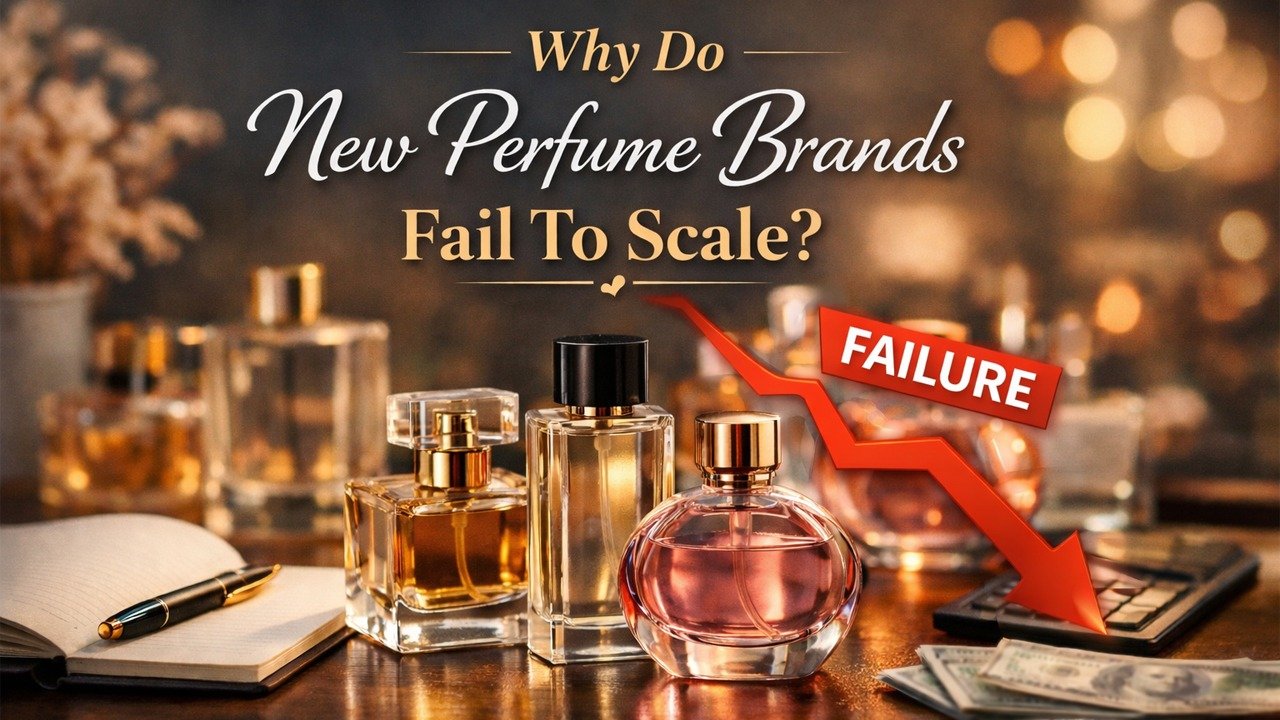
Why Do New Perfume Brands Fail To Scale?
Ever wonder why some perfume brands never make it big? Many entrepreneurs ask themselves why perfume brand is not growing, even after crafting luxurious fragrances and investing in stunning packaging. The reality is that success goes beyond a great scent; it’s about strong branding, smart marketing, and connecting with the right audience.
Many new perfume brands struggle because they fail to stand out in a crowded market or don’t build enough trust with customers. Understanding these challenges and avoiding common mistakes can help your perfume business scale effectively, turning your passion into a brand that thrives and captures attention.
Common Reasons New Perfume Brands Fail Scaling
Starting a fragrance line is a dream for many. You have a great scent, a beautiful bottle, and a big vision. However, many owners soon realize growth is harder than expected. Making a perfume is an art, but building a successful business requires strategy, marketing, and understanding customers. In this guide, we will look at the common mistakes that stop a small scent company from becoming a big name:
1. Lack of a Unique Identity
The perfume world is very crowded. If your scent smells like everything else on the shelf, people have no reason to switch. Many new owners face scaling perfume business issues because they try to copy famous brands.
If you make a fresh citrus scent for men that smells exactly like a designer brand, you are competing with million-dollar marketing budgets. To scale, you need a story. Maybe your brand uses rare ingredients from the Middle East, or perhaps it focuses on vegan, eco-friendly packaging. Without a hook, you are just another bottle on a shelf.
2. Weak Marketing and Storytelling
Perfume is an emotional purchase. People don't buy it just for the liquid; they buy it for how it makes them feel. One of the biggest perfume brand marketing mistakes is focusing only on the ingredients.
Instead of just saying "This has Jasmine and Musk," tell the customer when to wear it.
- Day: A light, airy scent for the office.
- Night: A deep, spicy Oud for a gala or dinner.
- Unisex: A bold, woody scent that works for anyone.
If your marketing doesn't create a vibe, your sales will stay flat.
3. High Costs and Low Margins
Money is a major factor in perfume brand failure reasons. The cost of glass bottles, high-quality caps, and the fragrance oil adds up quickly. If you spend too much on the bottle and not enough on the juice or vice versa, your profits will vanish.
Scaling requires buying in bulk. If you cannot afford to order 5,000 bottles at once, your cost per unit stays high. This makes it hard to sell to big retailers who want a discount. Managing your cash flow is just as important as the scent itself.
4. Poor Distribution Channels
You might have a great website, but if that is the only place people can find you, growth will be slow. Many owners struggle with why perfume sales are low because they ignore offline opportunities.
Perfume is sensory. People want to smell it before they pay $100. If you don't offer small sample sets or partner with local boutiques, you limit your reach. You need a mix of online ads and physical touchpoints where customers can experience the product.
5. Ignoring Customer Feedback
A brand that doesn't listen, doesn't grow. Sometimes a brand launches a "Heavy Winter Wood" scent for women, but the customers find it too strong. If the brand keeps pushing the same formula without listening, it will lose those customers.
To understand how to grow perfume brand awareness, you must engage with your community. Ask them what they want. Do they want a travel-size bottle? Do they want a longer-lasting formula? Happy customers are your best marketers.
6. Inventory and Supply Chain Struggles
If a famous influencer suddenly talks about your perfume, can you handle 1,000 orders in one day? Many perfume business growth problems start when a brand goes viral but has no stock.
If a customer waits three weeks for a bottle, they won't come back. Scaling means having a reliable factory and a shipping partner that can grow with you.
Comparison Table: Small Brand vs. Scaled Brand
Feature | Small Brand (Struggling) | Scaled Brand (Successful) |
|---|---|---|
Focus | Making any sale | Building a loyal community |
Product | One or two scents | A full collection (Day/Night/Season) |
Marketing | Posting photos of bottles | Telling stories and using influencers |
Inventory | Small batches, often out of stock | Bulk production and fast shipping |
7. Lack of Professional Help
Many entrepreneurs try to do everything themselves. They design the label, mix the oils, and manage the website. This works for the first 100 bottles, but it fails at 10,000.
To scale, you need professional manufacturing. Using a private label service can help you get high-quality products without the headache of DIY mixing.
Pro Tip: If you want to see how high-quality scents are made, check out the Oud Al Meydan collection for inspiration on premium ingredients and packaging.
8. Lack of Quality Consistency
One major reason new perfume brands struggle to scale is losing quality as production increases. Initially, the creator may handcraft each bottle with care, but growth often means shifting to a factory.
If the factory uses cheaper ingredients or different methods, the scent can change. Customers who loved the first bottle will be disappointed if the next one smells different or fades quickly. In the fragrance world, a brand is only as strong as its last bottle. Ensuring every bottle maintains the same quality is key to growth.
FAQ
1. Why do most perfume startups fail in the first year?
Most fail because they run out of money or fail to find a unique niche in the market.
2. How much does it cost to scale a perfume brand?
It varies, but you usually need a significant investment in inventory and digital ads to reach a national audience.
3. Is the perfume market too crowded?
It is crowded, but there is always room for unique, high-quality scents that solve a specific customer need.
4. How can I make my perfume last longer?
The concentration of fragrance oil (EDP vs. EDT) and the quality of fixatives determine the longevity.
5. Should I sell unisex perfumes?
Yes. The trend is moving toward unisex scents as more people choose fragrances based on notes rather than gender.
6. Do I need a physical store?
Not necessarily, but you do need a way to get samples into customers' hands.
7. What is the best way to market a new scent?
Social media storytelling and influencer reviews are currently the most effective ways for new brands.
8. How many scents should I launch with?
Starting with 3 distinct scents (e.g., one fresh, one floral, one woody) is a common strategy.
9. Can I use a private label for my brand?
Yes, private labeling allows you to focus on marketing while experts handle the production.
10. How do I find my target audience?
Look at who likes your scent notes. For example, if you use heavy Oud, your audience might be those who enjoy luxury, evening wear, and Middle Eastern styles.
Conclusion
Scaling a fragrance business is about more than just a nice smell. It requires smart money management, a strong brand story, and the ability to listen to your customers. If you avoid the common mistakes mentioned above, you can turn your small project into a household name.
If you are looking for high-quality scents or need help starting your journey, we are here to help. Contact us for expert advice and premium fragrance products.
Latest Posts